Doing the Work Means Protecting Communities — Not Rushing into Data Center Deals

Charleston keeps telling us, “We’ve done the work. Now we just need to follow through.” I respect anyone who wants to move West Virginia forward. But doing the work means understanding the consequences of the decisions we make — especially when those decisions reshape our communities, our water, and our infrastructure.
Right now, too many legislators are embracing a dangerous idea: just build the data center and hope everything else works out. That is not responsible governance, and it is not what the West Virginia Constitution envisions when it protects local self‑government.
Technology Is Moving Faster Than Our Laws
Google recently announced a new AI chip that reduces the carbon footprint of certain workloads. But even Google admits that the biggest impacts of AI data centers aren’t solved by a more efficient chip. They come from massive electricity demand, heavy water withdrawals, and strain on local roads and emergency services.
These impacts are local — yet Charleston continues to centralize authority at the exact moment when communities need more say, not less.
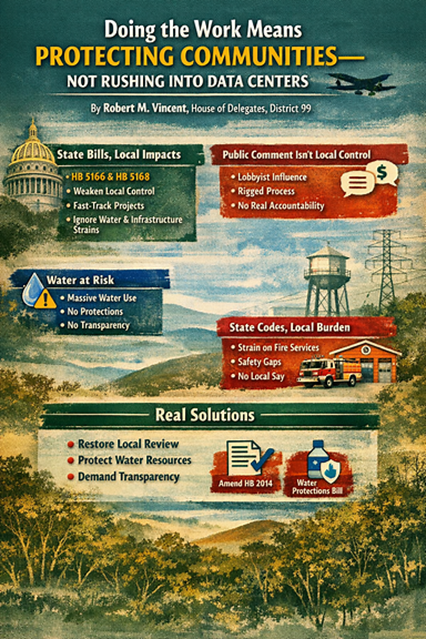
HB 5166 and HB 5168 Move Power Away From Communities
HB 5166 and HB 5168 accelerate large‑scale development while limiting local review. Counties lose the ability to evaluate water use, infrastructure strain, or emergency‑services capacity. These bills reflect a mindset that speed matters more than understanding — and that local voices are obstacles rather than partners.
Public Comment Is Not Local Control
Some point to the state’s rulemaking process under WV Code §29A‑3‑11 as proof that communities still have a voice. But a public comment period is not meaningful oversight. Corporations can flood the process with coordinated submissions, lobbyists can shape draft rules before the public ever sees them, and agencies are not required to act on comments. Counties have no guaranteed role, even when a project directly affects their water or infrastructure.
That is not transparency. And it is not accountability.
State Codes, Local Consequences
Under WV Code §29‑3‑2, the State Fire Commission sets building and fire codes that counties must enforce but cannot strengthen — even when a project dramatically increases local risk. Data centers bring high‑density electrical systems, battery arrays, and diesel generators that strain local fire departments. Yet counties cannot require additional safety measures or secure revenue to support emergency services.
This is exactly why local control matters.
Water Is a Survival Issue
Data centers can withdraw millions of gallons of water per day. Yet current law does not require public disclosure of water use, independent environmental assessments, or drought‑response plans. Google’s own research shows that water and electricity are the dominant drivers of environmental impact — not the chip inside the server.
Ignoring that reality puts our communities at risk.
Two Bills to Restore Balance
If elected, I will introduce two bills that put communities back at the center of decision‑making:
1. Amending HB 2014 to restore local review, return revenue to counties, and require transparency for major projects.
2. Strengthening water protections by requiring disclosure of projected water use, independent assessments, enforceable drought limits, and protections for drinking water and aquifers.
This is not anti‑development. It is pro‑community, pro‑transparency, and pro‑West Virginia.
Doing the Work Means Putting People First
We move forward when we listen before legislating, return authority to local governments, protect water and infrastructure, and ensure development benefits residents — not outside interests.
West Virginia is ready for growth. But readiness isn’t a slogan. It’s a responsibility. And I’m ready to do the work — with our communities, not over them.
Thanks for your time,
Rob Vincent
“Honest work. Real solutions. A Better West Virginia.”


Comments